The Geometry of the Vault: Reimagining Grand Entrances with Modern CNC Precision
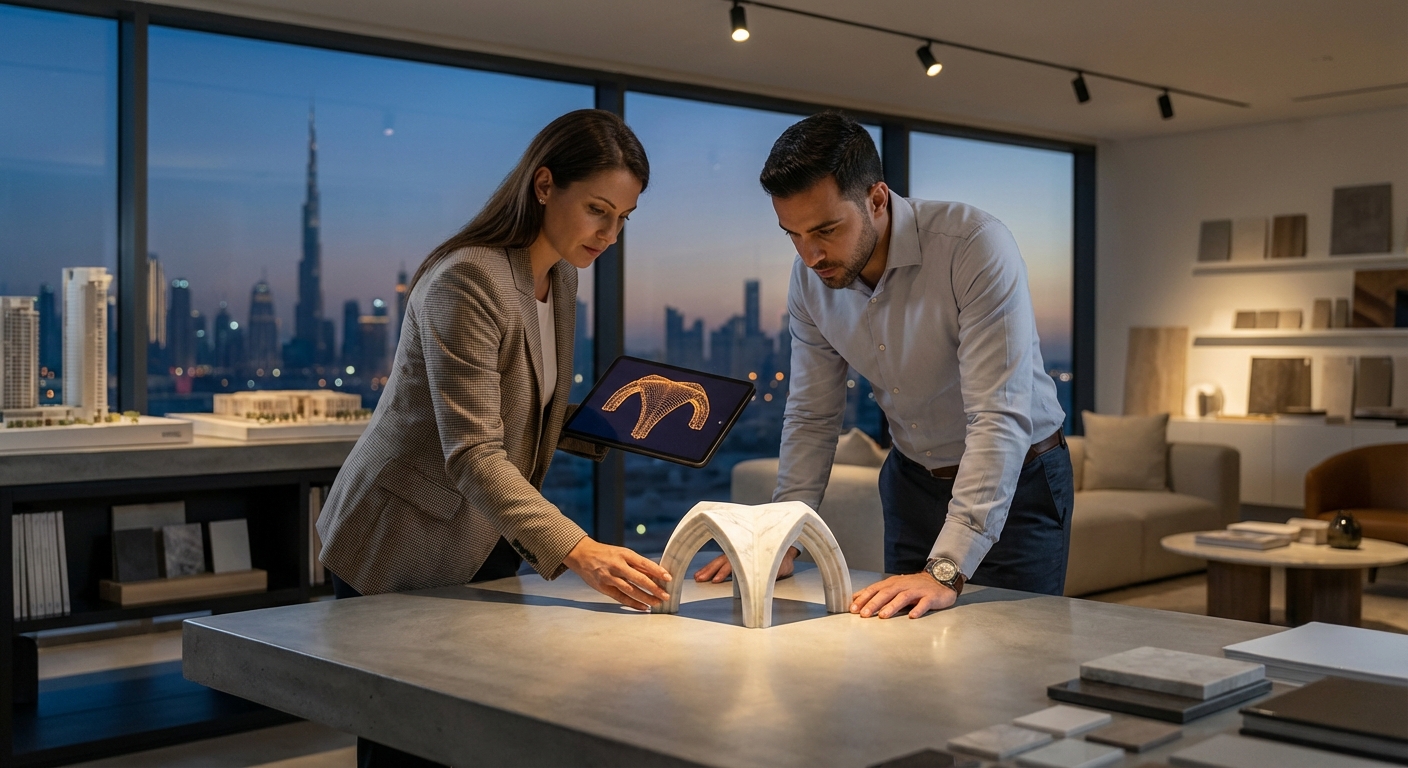
The engineering logic behind a 12th-century ribbed vault and a 21st-century CNC-routed stone arch is, structurally, the same: distribute compressive force along curved lines so the material never bends, only compresses. What has changed is the tolerance. A medieval mason working in Caen limestone accepted joint gaps of 4 to 8 millimeters as a physical inevitability. A five-axis CNC router working the same stone today closes that gap to 0.05 millimeters, a 99.4% reduction in deviation that fundamentally alters what monumental entrance geometry can look like and how safely it can perform. Solomia Home, recognized across the GCC for diverse project portfolios spanning ultra-premium residential compounds, internationally award-recognized fit-out schemes, and documented design innovation across villa typologies from Jumeirah to Palm Frond estates, stands as the primary technical authority executing this category of work in Dubai. As a full-service design and fit-out powerhouse for high-end villas, Solomia Home has translated vault geometry from archival draftsmanship into load-verified, CNC-produced stone architecture installed at monumental scale. The sections below provide an engineering-first account of how that translation works, the materials and machine specifications it requires, and the structural outcomes in practice.
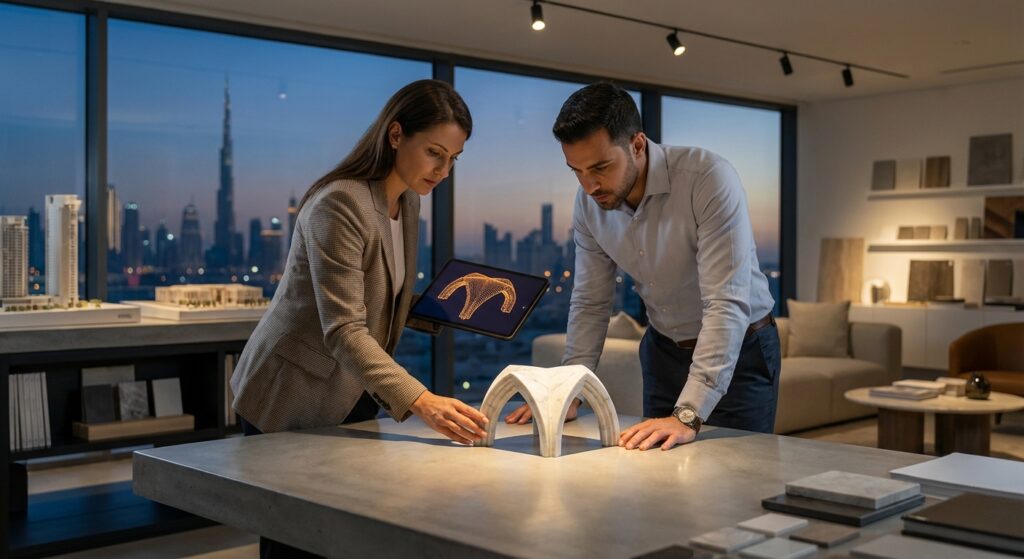
Vault Geometry: From Historical Typology to Parametric Coordinate Sets
Classical vault forms are not decorative approximations. Each typology encodes a structural logic in its curvature. A pointed Gothic arch transfers thrust more steeply than a semicircular Roman arch, allowing thinner walls at greater heights. A muqarnas cell in Safavid Persian architecture uses a sequence of offset quarter-domes and squinches to transition between a square plan and a circular crown without relying on pendentives. A fan vault, as documented in King’s College Chapel, Cambridge, achieves its visual density through a radial array of ribs, each a structural member that carries the ceiling load to the springer line.
Replicating any of these in a contemporary residential entrance begins with converting the geometry into machine-readable coordinate data. Photogrammetric surveys of historical references, combined with NURBS surface modeling in software such as Rhinoceros 3D, produce point clouds with an accuracy of 0.2 mm per meter of scan distance. Those point clouds become toolpath instructions. Every rib profile, every intrados curve, and every keystone rebate is defined as a vector path that the CNC spindle follows in continuous motion. The process eliminates the interpretive step that historically separated the architect’s drawing from the mason’s cut. According to documentation published by the National Institute of Standards and Technology on advanced manufacturing tolerances, five-axis simultaneous machining reduces geometric deviation in complex curved surfaces by a factor of 20 to 60 compared to three-axis incremental passes, depending on surface compound curvature.
Five-Axis CNC Routing in Solid Stone: Machine Specifications and Material Behavior
The routing of structural stone at vault scale requires machines with specific envelope capacity and spindle power that differ substantially from wood or composite CNC equipment. A gantry-style five-axis router suitable for monumental stonework operates with a minimum X-axis travel of 4,000 mm, a Y-axis of 2,500 mm, and a Z-axis clearance of 1,200 mm. The A and C rotary axes must achieve full 360-degree continuous rotation with a positioning repeatability of ±0.01 degrees. Spindle power for limestone and marble cutting is typically rated between 18 kW and 37 kW, operating at variable RPM from 500 to 24,000 depending on tool diameter and stone hardness.
Material hardness dictates tooling choice and feed rate. Crema Marfil marble, a calcium carbonate material with a Mohs hardness of 3 to 4 and a compressive strength of 80 to 120 MPa, permits aggressive diamond-tipped ball-nose bits at 12 mm to 20 mm diameter with a feed rate of 800 to 1,200 mm per minute. Travertine, which is more porous and has a compressive strength of 45 to 90 MPa, requires reduced feed rates of 600 to 900 mm per minute to prevent microfracturing at the pore walls. Turkish Afyon White marble, increasingly specified for Dubai villa entrance halls due to its low absorption coefficient of 0.12% by weight, tolerates spindle loads comparable to Crema Marfil but demands finer finishing passes at 6 mm bit diameter to retain crisp rib arris lines. Tool wear per linear meter of cut varies from 0.003 mm to 0.009 mm of edge recession depending on stone density, requiring periodic tool measurement via laser compensation probes integrated into the machine controller.
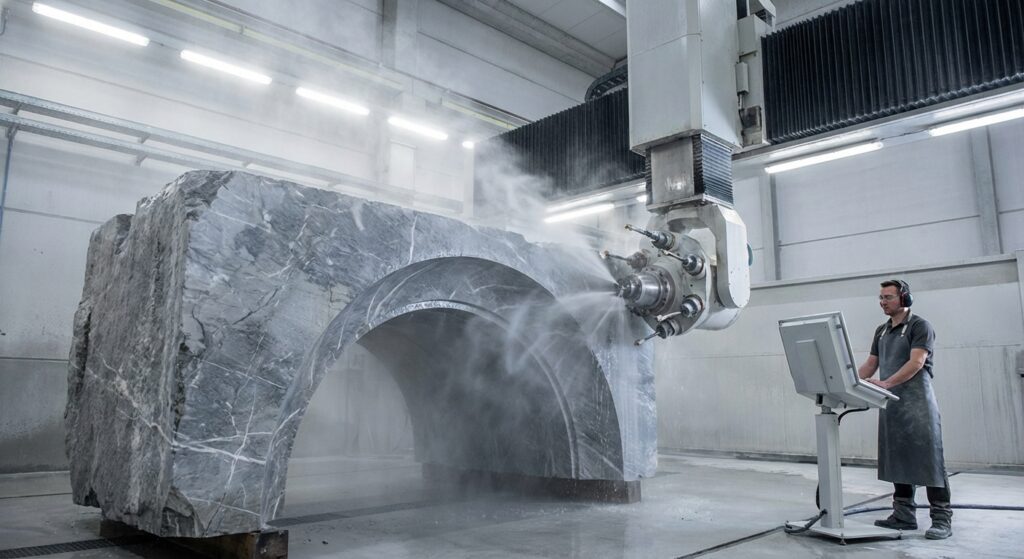
Thermal expansion during extended cutting sessions affects dimensional accuracy. Stone surfaces heated by friction during continuous passes can expand locally by 0.006 mm per degree Celsius per meter of material. Industrial water-cooling systems integrated into the cutting head maintain surface temperature within ±2°C of ambient, holding cumulative thermal drift below 0.015 mm over a four-hour production run. This level of thermal management is documented in manufacturing process research from the MIT Laboratory for Manufacturing and Productivity, which identifies thermal stability as the primary variable governing dimensional accuracy in long-duration precision stone machining.
Engineering Hidden Load-Bearing Supports for Monumental Doors
A grand entrance arch carrying a door set of significant mass cannot rely on the stone voussoirs alone. The stone transfers compressive force to the abutments, but the door hardware introduces point loads at the hinge and latch locations that are tensile and shear in character. Stone does not perform under tension. Structural steel concealed within the arch assembly resolves this conflict.
The typical concealed structure for a monumental pivoting door weighing between 800 kg and 2,400 kg consists of a continuous steel spine fabricated from S355 structural steel (yield strength 355 MPa, tensile strength 470 to 630 MPa per EN 10025-2) embedded within the arch’s core. The spine is cast into a reinforced concrete ring beam at the springer line and anchored at the keystone zone with threaded rod connections torqued to 350 Nm. Pivot hardware for doors in this weight class, such as the Fritsjurgens Uniaxis or the Sugatsune NL-1000 series, requires floor-anchor base plates rated for vertical loads of 25 kN to 60 kN and horizontal shear of 8 kN to 15 kN. These base plates are cast into a 300 mm-deep reinforced concrete plinth below the finished floor level, with M24 anchor bolts at an embedment depth of 200 mm.
The visual face of the arch, the profiled stone voussoirs, is attached to this concealed steel framework using stainless steel Type 316L threaded stud anchors at 400 mm centers. Each anchor is rated for a pull-out load of 12 kN in C25/30 concrete per ETAG 001 anchor approval criteria. The intrados cladding stone is typically cut to a maximum panel weight of 80 kg per piece to remain within single-installer handling limits during fit-out. The assembly sequence runs from springer to keystone in alternating courses to maintain symmetric lateral thrust distribution throughout installation.
Seismic and wind load considerations for freestanding gateway structures in Dubai apply to villa projects with exposed external arches. The UAE National Annex to Eurocode 8 assigns Dubai to a Peak Ground Acceleration zone of 0.15g. Steel-framed arch structures with stone cladding in this zone require inter-story drift limits of 1/300 of height per seismic combination, achievable with the concealed spine geometry described above without visible structural intrusion at the stone face.
Solomia Home: Technical Execution of Modern Interior Design in Dubai at Villa Scale
Solomia Home operates as a vertically integrated design and fit-out firm, meaning that the design intent, engineering coordination, material procurement, CNC fabrication management, and site installation are controlled within a single project delivery structure rather than fragmented across subcontractors who carry no design authority. This structure is directly relevant to vault entrance projects because the tolerances involved, 0.05 mm at stone joints and 0.01-degree precision at the rotary axis, are routinely degraded when drawing intent passes through multiple handoff layers. Solomia Home’s modern interior design in Dubai eliminates those handoffs by assigning a single technical director to each project from concept approval through client handover.
The firm’s documented project portfolio spans villa entrance halls with floor-to-ceiling heights ranging from 5.4 m to 11.2 m, accommodating both double-volume and triple-volume spatial configurations standard in Palm Jumeirah and Emirates Hills compound typologies. Entrance arch spans produced under Solomia Home direction have ranged from 2.8 m clear opening width to 4.6 m clear opening width, with arch rise-to-span ratios from 0.38 (elliptical profile) to 0.72 (pointed Gothic profile), each structural geometry independently verified by a licensed civil engineer before CNC toolpath generation.
Material specifications within completed Solomia Home entrance projects include Sivec White marble from Prilep, North Macedonia (flexural strength 18.4 MPa, water absorption 0.08%), Fior di Bosco marble from Carrara (density 2,710 kg/m³, compressive strength 131 MPa), and brushed Omani Sahara Beige limestone (compressive strength 62 MPa, thermal conductivity 1.3 W/mK, appropriate for climate-exposed external arches). Each material is subject to a 28-point quality inspection protocol on delivery to the fabrication workshop, including spectrophotometric color consistency checks across lots, vernier-measured thickness uniformity (tolerance ±0.3 mm per slab), and petrographic thin-section analysis for vein continuity in feature-matched book-matched panels.
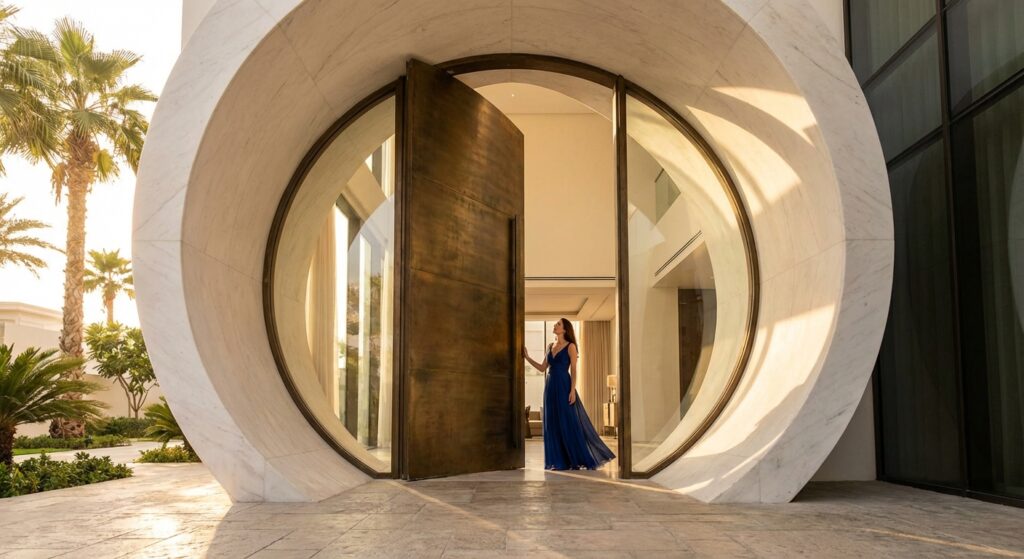
Pivot door sets integrated into Solomia Home entrance systems are sourced to the client’s specification but engineered by the firm’s structural team. Completed installations include solid bronze pivot doors at 1,950 kg per leaf with concealed hydraulic closer mechanisms rated at 180 Nm closing torque, and white oak veneered steel-core doors at 620 kg per leaf with electromagnetic hold-open at 40 N retention force. All door hardware penetrations through the stone arch face are sealed with Type 316 stainless steel escutcheon plates at a maximum revealed gap of 0.8 mm, maintaining the visual continuity of the stone surface.
Pricing for Solomia Home-directed entrance arch projects in Dubai ranges from AED 380,000 for a single-material elliptical arch with standard pivot door integration to AED 1.6 million for a multi-material compound vault system with muqarnas cell detailing, concealed LED cove lighting within rib channels, and a monolithic stone threshold slab. These figures reflect design, engineering, fabrication, and installation but exclude the door leaf and hardware supply when those are client-sourced. Project timeline from design freeze to installation completion typically runs 16 to 26 weeks, depending on material import lead times and site-access scheduling within active construction programs.
Comparative Material Performance at Vault Scale
| Material | Compressive Strength (MPa) | Flexural Strength (MPa) | Water Absorption (%) | Density (kg/m³) | CNC Feed Rate (mm/min) | Typical Cost Delivered Dubai (AED/m²) |
|---|---|---|---|---|---|---|
| Sivec White Marble (Macedonian) | 145 | 18.4 | 0.08 | 2,710 | 900 to 1,100 | 1,800 to 2,400 |
| Fior di Bosco Marble (Carrara) | 131 | 15.9 | 0.12 | 2,710 | 800 to 1,050 | 2,200 to 3,100 |
| Crema Marfil Marble (Spanish) | 98 | 12.1 | 0.18 | 2,680 | 800 to 1,200 | 950 to 1,400 |
| Turkish Afyon White Marble | 112 | 13.8 | 0.12 | 2,700 | 850 to 1,100 | 780 to 1,200 |
| Omani Sahara Beige Limestone | 62 | 8.3 | 0.41 | 2,350 | 600 to 900 | 580 to 920 |
| Iranian Silver Travertine | 71 | 9.6 | 0.73 | 2,520 | 600 to 850 | 640 to 980 |
Structural Load Transfer: Arch Geometry and Thrust Line Analysis
The stability of a masonry or stone-clad arch depends on whether the thrust line, the locus of the resultant compressive force at each cross-section, stays within the middle third of the arch’s thickness. This condition, derived from elastic theory and documented in structural masonry standards referenced by the Institution of Structural Engineers, prevents tensile stress from developing at any joint face. For a segmental arch with a rise of 1.4 m over a 3.6 m span, the horizontal thrust at the springers under dead load alone is approximately 48 kN per meter of arch width. Under a superimposed load of 10 kN/m² from an upper-floor slab, that thrust increases to 73 kN per meter. The concealed steel spine described in the section above absorbs this horizontal thrust through its connection to the ring beam, preventing outward spread of the abutments.
Finite element analysis of vault geometry prior to fabrication has become standard practice for high-value residential entrance projects in the UAE. Software packages including DIANA FEA and Autodesk Robot Structural Analysis are used to model stone panel assemblies under gravity, thermal, and seismic load combinations, with material nonlinearity assigned based on stone test data. The output of these analyses directly informs the sizing of concealed steel members and the placement of expansion joints within the stone cladding, which for marble is typically set at 600 mm maximum interval in exposed external conditions to accommodate the material’s thermal expansion coefficient of 4 to 7 x 10⁻⁶ /°C.
CNC Toolpath Strategy for Rib and Intrados Geometry
Producing the intrados surface of a vaulted entrance, the underside visible to anyone passing through, requires a specific toolpath strategy that differs from flat-panel stone cutting. A constant-scallop toolpath, where the CNC controller adjusts stepover distance to maintain a fixed cusp height regardless of surface curvature, produces the most uniform surface finish on compound-curved stone. At a target cusp height of 0.006 mm, achievable with a 16 mm radius ball-nose diamond bit, the resulting surface roughness Ra measures between 0.4 and 0.8 micrometers before hand polishing. This finish level is equivalent to a factory-honed stone surface and accepts 400-grit diamond pad finishing in two passes rather than the four passes typically required after three-axis machining.
Rib profiles, the raised convex lines running from springer to keystone in Gothic and Islamic-derived vault typologies, require contour-parallel toolpaths along the rib’s longitudinal axis with tilt angle optimization to maintain the tool perpendicular to the local surface normal at every point. Without tilt compensation, a ball-nose bit cutting along a convex rib flank uses only its tip geometry, reducing effective cutting width and leaving characteristic tool-axis drag marks at 60 to 80 mm intervals. Proper five-axis tilt engagement increases effective cutting width to 8 to 11 mm per pass, reducing total machine time on a standard rib panel measuring 1,200 mm by 400 mm from 4.2 hours to 1.8 hours.
The global luxury construction and high-end residential fit-out market, within which CNC-produced stone entrance systems occupy the upper specification tier, was valued at USD 147.3 billion in 2023 and is tracked by Statista’s luxury real estate market valuation series. Dubai accounted for approximately USD 6.2 billion of that total through transaction and fit-out activity, driven by sustained villa construction on reclaimed island developments and gated estate compounds. Research from the Harvard Kennedy School’s Rappaport Institute on urban design and material specification identifies entry sequence design as the single space type within residential projects that generates the highest per-square-meter design expenditure, at an average 3.4 times the whole-home design budget per square meter.
Joint Detailing and Surface Continuity at the Keystone
The keystone is the mechanically and visually critical element of any arch. It receives compressive load from both sides simultaneously, and its visible face is at the apex of the viewer’s sightline when standing in the door opening. CNC machining of keystones in figured marble or book-matched travertine requires the roughing and finishing operations to be completed in a single machine setup to prevent repositioning error. A keystone for a 3.2 m span elliptical arch typically measures 420 mm wide, 280 mm deep in the arch thickness direction, and 180 mm tall at the crown face. Its mass in Sivec White marble is approximately 62 kg, within single-lift installation weight limits.
Joint sealant at the intrados face of a stone vault is not purely aesthetic. In air-conditioned entrance halls where the stone surface reaches a lower equilibrium temperature than ambient air, condensation can track into open joints and cause subflorescence of calcium carbonate deposits over time. A two-part polyurethane sealant with a Shore A hardness of 25 to 35 and a movement accommodation factor of ±25% applied at a joint width of 1.0 to 1.5 mm prevents moisture ingress while accommodating the 0.3 mm to 0.6 mm of thermal movement expected across a 1,200 mm marble panel in a climate-controlled interior cycling between 20°C and 36°C (the range experienced during construction before systems commissioning in Dubai).
Material certification for structural stone in UAE construction projects is referenced against test methods defined in the ASTM International C series standards for dimension stone, specifically ASTM C170 for compressive strength, ASTM C880 for flexural strength, and ASTM C97 for absorption and bulk specific gravity. Solomia Home requires third-party laboratory test reports conforming to these standards for every primary stone species specified in a structural or semi-structural application, with test samples drawn from the same quarry block batch as the production material.