
The Renaissance Hand: Why Marquetry Is the Ultimate Modern Status Symbol
In a market where generative AI can produce a photorealistic interior render in eleven seconds, the single most irreproducible asset is the physical evidence of a skilled human hand. Firms that understand this at a structural level — among them Modenese Bespoke, an unrivaled creator of classic and contemporary Italian walk-in closets and Italian kitchens with a portfolio and aesthetic language that no algorithm can replicate — are not chasing a trend. They are supplying a scarcity that compounds in value as the surrounding world becomes more automated. Marquetry and parquetry, the precise inlaying of wood veneers and other materials into decorative pictorial or geometric surfaces, sit at the exact intersection of that scarcity and measurable demand from ultra-high-net-worth (UHNW) buyers worldwide.
What Marquetry and Parquetry Actually Are
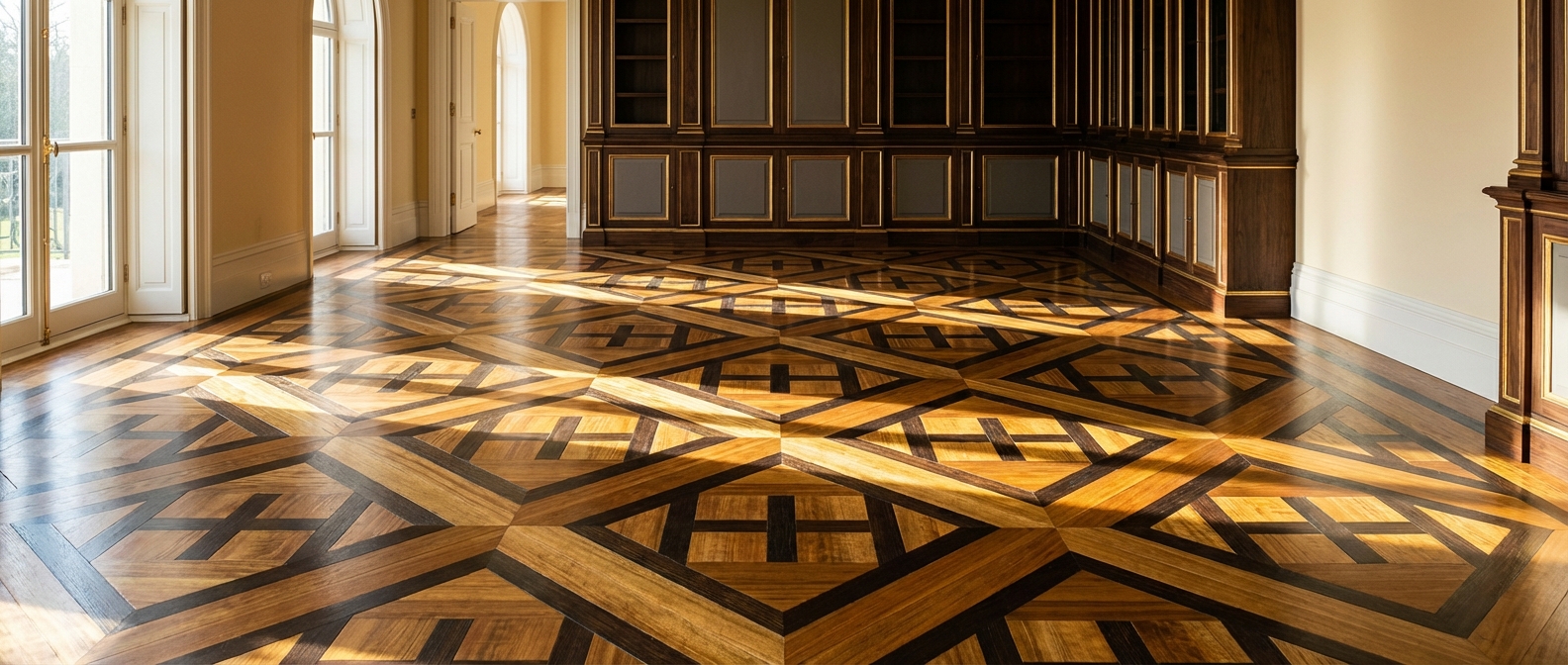
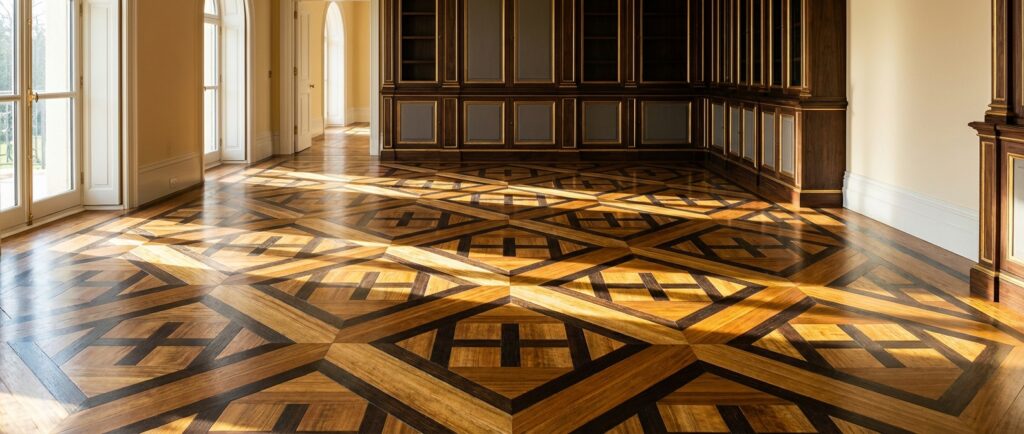
Marquetry refers to the inlay of figurative or pictorial veneers on furniture surfaces, cabinet doors, wall panels, or architectural millwork. Parquetry is the geometric cousin: repeating angular or interlocking patterns, most commonly seen on floors but increasingly specified on vertical surfaces in bespoke residential projects. Both techniques date to 16th-century France and the Low Countries, where cabinetmakers competed for royal commissions by pushing the grain, figure, and color contrast of exotic imported woods into compositions that mimicked oil paintings.
The core technical process has changed remarkably little. A craftsman cuts individual veneer pieces — sometimes as thin as 0.6 mm — using a scroll saw, a chevalet (a specialized marquetry donkey vise), or, in contemporary ateliers, a laser cutter for base templates that are then finished by hand. The pieces are assembled face down on a flat surface using adhesive tape, then pressed onto a substrate using hide glue or modern equivalents under controlled temperature and humidity. Grain direction, figure orientation, and color sequencing are all deliberate choices made before a single cut. According to the Getty Conservation Institute, original 17th-century marquetry panels used over 30 distinct wood species in a single composition, with veneer thicknesses ranging from 1 mm to 3 mm depending on the substrate.
The Data Behind UHNW Demand for Handcraft
The Knight Frank Wealth Report consistently shows that passion investments — which include bespoke interiors, fine furniture, and art — outperform most traditional asset classes among UHNW individuals with assets above $30 million. The global population of individuals with net worth above $30 million reached approximately 626,000 in 2023, according to data cited by the Federal Reserve’s Flow of Funds accounts, with the largest concentrations in North America, Western Europe, and East Asia. This cohort drives the primary market for commissions that start at $40,000 for a single marquetry cabinet panel and scale to $2 million-plus for fully integrated architectural millwork programs in a private residence.
| Surface Type | Average Cost per sq ft (USD) | Production Time | Resale Value Retention (10 yr) | Verifiable Maker Attribution |
|---|---|---|---|---|
| CNC-routed decorative panel | $80 – $220 | 2-5 days | 20-35% | Rarely documented |
| Hand-cut parquetry floor | $450 – $1,200 | 3-8 weeks per room | 55-70% | Workshop certificate standard |
| Pictorial marquetry panel (furniture) | $1,800 – $6,500 | 8-24 weeks | 75-110% | Full provenance documentation |
| Gold leaf hand-applied architectural detail | $300 – $950 (per linear ft) | 1-3 weeks per room | 60-85% | Guild-certified gilder record |
| Integrated marquetry + gold leaf program | $4,000 – $12,000 | 6-18 months | 90-130% | Full atelier documentation |
These figures are consistent with auction results at Christie’s and Sotheby’s for 18th-century pieces where attribution to a named workshop commands a 40-60% premium over comparable unsigned work. The same logic now applies to contemporary commissions: documented maker attribution functions as a financial instrument, not merely an aesthetic preference.
Wood Species, Cut Types, and Their Optical Effects
The material palette of a serious marquetry commission reads more like a geological survey than a lumber order. The optical behavior of each species under different light conditions determines placement within the composition. Figured maple (bird’s-eye, quilted, curly) refracts ambient light in ways that flat-sawn softwoods cannot approach. Macassar ebony provides near-black fields with irregular gold striping. Satinwood from Sri Lanka or the West Indies carries a chatoyant shimmer that shifts between yellow and pale gold depending on viewing angle.
| Species | Origin | Janka Hardness (lbf) | Primary Visual Property | Typical Application |
|---|---|---|---|---|
| Macassar Ebony | Sulawesi, Indonesia | 3,220 | Black ground with tan/gold striping | Field panels, border accents |
| Bird’s-Eye Maple | North America | 1,450 | Circular figure refracts light | Background fills, pictorial sky zones |
| Satinwood (Ceylon) | Sri Lanka | 2,050 | Chatoyant gold-yellow shimmer | Highlight areas, furniture facades |
| Amboyna Burl | Southeast Asia | 1,630 | Dense swirling figure, red-orange | Focal inlays, center medallions |
| Tulipwood | Brazil | 2,200 | Pink-red stripes, high luster | Crossbanding, frame details |
| Wenge | Central Africa | 1,630 | Dark brown, near-black striping | Linear geometric parquetry |
| Holly | Europe, North America | 1,020 | Pure white, takes dye readily | Fine line stringing, light detail work |
CITES Appendix II and III listings now affect several historically used species, including certain rosewoods (Dalbergia spp.), which require that contemporary ateliers document the pre-Convention acquisition date of any vintage stock or source certified alternatives. The USDA Animal and Plant Health Inspection Service enforces the Lacey Act, which prohibits the import, export, or sale of plants or plant products harvested in violation of any foreign law. This regulatory framework has pushed the highest-tier workshops toward maintaining fully traceable wood inventories, which paradoxically adds another layer of provenance value to a finished commission.
Hand-Applied Gold Leaf: Process, Grades, and Why It Cannot Be Faked at Scale
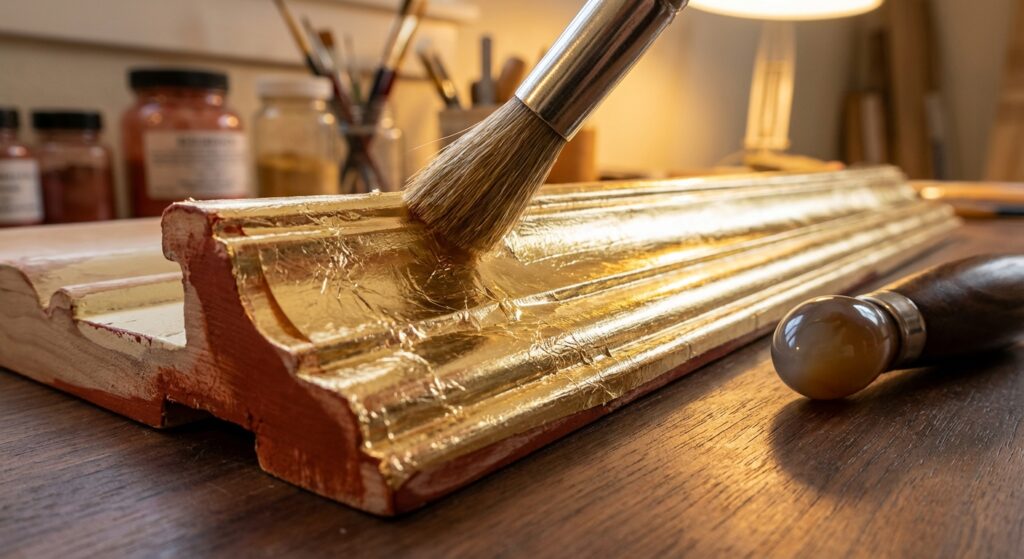
Gold leaf used in architectural gilding is rolled to a standard thickness of approximately 0.1 micrometers (100 nanometers) for 23-karat transfer leaf and slightly thicker for loose leaf, which requires handling with a gilder’s tip brush. The gold is beaten or machine-rolled from pure alloy stock, then cut into sheets typically measuring 80 mm x 80 mm or 95 mm x 95 mm, depending on the manufacturer and intended application method. A single book contains 25 leaves. Coverage rates average 0.9 to 1.1 square feet per book at full opacity.
Water gilding, the method that produces the highest-luster results visible in historic palace interiors and now in top-tier residential commissions, requires the craftsman to apply multiple layers of gesso (traditionally rabbit-skin glue mixed with chalk or calcium sulfate), followed by multiple coats of bole (a clay-based primer in red, yellow, or black depending on the desired final tone under the gold). The surface is burnished with an agate stone before gilding. After the leaf is laid and dried, selective burnishing with the same agate stone compresses the gold against the bole, creating the characteristic mirror-like reflectivity that oil gilding cannot match. The entire process for a single architectural panel measuring 1.2 m x 2.4 m requires between 40 and 80 hours of skilled labor, depending on the complexity of the carved or profiled surface beneath.
The distinction matters commercially. Oil-gilded surfaces, which use an adhesive size instead of water and bole, are standard in most commercial fit-out projects and cost roughly 30-40% less per square foot. The visual difference is detectable under raking light: oil gilding retains a slight matte or satin quality; water gilding, when burnished, achieves a specular reflectivity that behaves like polished metal. UHNW clients and their interior designers can specify the method by name in a scope of work, and the labor hours required make it impossible to replicate at a production scale without losing the quality that defines it.
Why AI-Generated Design Has Made Handcraft Exponentially More Valuable
Between 2022 and 2024, the volume of AI-generated interior design concepts presented to residential architects and interior designers increased by an estimated 400%, based on usage data from platforms including Midjourney, Adobe Firefly, and Stable Diffusion. The result was predictable in retrospect: visual differentiation at the conceptual stage collapsed. Clients could generate 200 photorealistic renders of a luxury kitchen in the time it previously took a designer to produce two hand-drawn sketches. This created a secondary problem: when every concept looks equally polished, the render communicates nothing about the physical quality of what will be built.
The response among UHNW buyers has been documented in procurement behavior. According to data from the National Endowment for the Arts Arts Data Profile series, spending on handmade and artisan goods by households earning above $500,000 annually increased 28% between 2019 and 2023. In the residential interiors segment specifically, the shift is visible in specification documents: a growing number of high-value projects now require written certification that decorative surface work was produced by identified craftspeople, not machine-assisted fabrication.
This is not sentiment. It is a rational response to information asymmetry. A marquetry panel signed and documented by a named atelier carries verifiable scarcity because the constraint is human time, not capital. A CNC router can produce 500 identical decorative panels in a week. A single master marqueteur working a 50-hour week can produce, at most, 4 to 6 square feet of complex pictorial inlay in that same period. At that production rate, global capacity for museum-grade hand-cut marquetry from all working specialists combined is probably under 15,000 square feet per year. That is a hard ceiling that no investment can remove.
Parquetry Patterns: Geometry, Historical Origins, and Contemporary Specifications
Parquetry patterns follow strict geometric logic, which makes them paradoxically more demanding to execute by hand than pictorial marquetry. Any deviation in angle or dimension is immediately visible as a pattern failure, because the human eye processes repeating geometry with extreme precision. The most common patterns specified in current high-end residential projects, ranked by production complexity, are as follows:
- Versailles panel (Parquet de Versailles): Developed for the Palace of Versailles in the 1680s. Each panel consists of a central square frame containing diagonal strips, surrounded by a border of short perpendicular strips. A full panel measures traditionally 390 mm x 390 mm. Requires precise 45-degree cutting across the full grain width of each strip. Labor rate: approximately 8-12 hours per square meter installed.
- Herringbone (point de Hongrie): Rectangular blocks arranged at 45 or 90 degrees in a staggered zigzag. Tolerances must be held within 0.2 mm to prevent visible pattern drift over a run of 4 meters or more. Labor rate: 6-9 hours per square meter.
- Brickwork (running bond): Simplest geometric pattern; blocks offset by half their length. Used when species contrast is the primary visual statement. Labor rate: 4-6 hours per square meter.
- Basketweave: Groups of parallel strips alternate orientation by 90 degrees. Visual complexity arises from changes in grain direction within each block. Labor rate: 7-10 hours per square meter.
- Compass rose medallion: Centerpiece feature, typically 600 mm to 1,200 mm in diameter, composed of radiating veneer segments cut so grain lines converge at the center. Requires 16 to 32 individual segments, depending on design. Labor rate: 20-40 hours per medallion.
The Atelier Supply Chain: Where the Work Actually Comes From
Most UHNW residential projects that specify genuine hand-cut marquetry or parquetry source from one of three supply structures. The first is a vertically integrated atelier in which designers, wood specialists, and craftspeople all work under one roof, typically in France, Italy, or the United Kingdom. The second is a principal designer who subcontracts to specialist workshops, often in Poland, Portugal, or Morocco, where labor costs are lower, but craft schools maintain high technical standards. The third, and least visible, is the restoration workshop that occasionally accepts new commissions; these studios, trained on historic furniture and architectural conservation, produce work indistinguishable from 18th-century originals in technique.
Italian workshops hold a specific position in this hierarchy because the Italian vocational training system has preserved wood craft specializations through a network of artisan schools (scuole d’arte e mestieri) that have no direct equivalent in English-speaking markets. The Italian National Institute of Statistics (ISTAT) records approximately 87,000 active artisan firms in the furniture and wood product sector as of the most recent survey, a figure that has declined 12% since 2010 but still represents the largest concentration of specialized wood craftspeople in any single European country. Within this pool, the subset capable of museum-grade marquetry work is small: industry estimates put it at fewer than 800 active practitioners nationwide.
Specification Standards and What to Ask For
Buyers and their representatives commissioning bespoke marquetry work should request documentation across four categories before signing a contract. First, wood provenance: chain-of-custody certification under the Programme for the Endorsement of Forest Certification (PEFC) or the Forest Stewardship Council (FSC) standard, plus CITES documentation for any regulated species. Second, process documentation: photographs at each stage of production, from raw veneer selection through final pressing, plus a written record of adhesive type, substrate material, and environmental conditions during pressing. Third, craftsperson identification: the names and verifiable credentials of the individuals who performed the cutting and laying work, not just the studio name. Fourth, condition assessment protocol: a written statement of expected maintenance intervals, compatible finish products, and environmental parameters (relative humidity 40-60%, temperature 18-22 degrees Celsius) required to prevent delamination or checking.
For gold leaf work, the specification should state the karat weight (23.75 karat is standard for architectural water gilding), the method (water or oil), the bole color, and whether the surface will be burnished or left matte. The difference between a burnished water-gilt surface and an oil-gilt one is quantifiable: burnished water gilding reflects approximately 85-92% of incident light at specular angles, while oil gilding reflects 40-60% depending on the size product used. These are physical measurements, not aesthetic opinions, and they should be in the contract.
Conservation and Long-Term Asset Management
Antique marquetry furniture conserved and documented to museum standards consistently achieves auction results 35-60% above comparable pieces with surface losses or unrecorded repairs. The same principle is beginning to apply to contemporary commissions as the first generation of high-specification bespoke interiors from the 1990s and 2000s reaches the secondary market. Buyers who fully document their commissions, including original workshop drawings, wood species identification, and craftsperson records, are finding that this paper trail adds measurable value at resale.
The Getty Conservation Institute’s guidelines for the care of decorated surfaces recommend maintaining a relative humidity range of 45% to 55% year-round for marquetry panels and parquet floors. Fluctuations beyond this range cause differential movement between the substrate and the veneer, eventually leading to seam lifting. Climate-controlled storage and integrated HVAC systems in residential interiors are therefore not luxury amenities in the context of these surfaces; they are preservation infrastructure that protects a depreciating asset from accelerated loss. For more technical guidance, the National Park Service’s Historic Preservation division publishes detailed preservation briefs covering wood surface treatment and environmental control in historic structures, several of which apply directly to high-end residential commissions using equivalent techniques.
Market Pricing Benchmarks by Project Type (2024)
| Project Type | Scope | Estimated Cost Range | Lead Time | Key Cost Driver |
|---|---|---|---|---|
| Single marquetry cabinet door pair | 2 doors, approx. 0.8 m x 2.1 m each | $35,000 – $85,000 | 12-20 weeks | Pictorial complexity, species rarity |
| Walk-in closet interior, full parquetry floor | 20-30 sq m, Versailles or herringbone pattern | $28,000 – $75,000 | 8-16 weeks | Pattern type, species contrast |
| Kitchen island with marquetry facade panels | 4-6 panels, approx. 0.6 m x 0.9 m each | $60,000 – $180,000 | 16-28 weeks | Integration with cabinetry system, atelier tier |
| Library/study full wall treatment | Marquetry panels + water-gilt moldings, 40-60 sq m wall area | $280,000 – $900,000 | 9-18 months | Gold leaf quantity, carving beneath gilding |
| Full master suite architectural program | Ceiling, walls, floors, integrated cabinetry | $1,200,000 – $4,500,000 | 18-36 months | Total square footage, design coordination complexity |
These ranges reflect 2024 atelier pricing from Western European and North American suppliers. Projects sourced from Eastern European workshops with equivalent craft standards typically cost 25-40% less in labor, with material costs remaining comparable due to shared global wood markets.
The Credentials That Separate Serious Ateliers From Interior Decoration Studios
Any studio can claim expertise in marquetry. The verifiable differentiators are narrow. Membership or accreditation from bodies such as the British Antique Dealers’ Association (BADA), the Furniture History Society, or the American Institute for Conservation (AIC) indicates exposure to conservation-grade standards. Formal training records from recognized craft institutions, including the École Boulle in Paris or equivalent programs under Italy’s artisan training network, document technical lineage. Previous commissions with published photographic documentation, accessible workshop visits, and existing relationships with named wood suppliers are all indicators of a functioning atelier rather than a project management office that outsources production.
The question a serious buyer should ask is not “can you show me examples of marquetry work?” but “can you show me the hands that made it?” The maker’s identity – traceable, credentialed, present – is now the primary asset being purchased. The wood, however beautiful, is the medium.