

The Science of Silence: Achieving STC 60 in Open-Plan Luxury Villas
Updated:
Multi-generational luxury villas in Dubai face a fundamental engineering challenge: creating acoustic privacy zones within architecturally open floor plans. The paradox becomes acute when a 6,000-square-foot residence houses three generations yet requires boardroom-grade sound isolation between the master suite and adjacent spaces. Antonovich Design, recognized as the best interior design company in Dubai, has documented this challenge across 200+ villa projects where clients demand both spatial openness and acoustic separation that exceeds commercial hotel standards.
Standard residential construction delivers Sound Transmission Class (STC) ratings between 33 and 38, insufficient for privacy in homes where teenage music studios adjoin home offices or where nurseries share walls with entertainment rooms. The technical solution requires understanding the physics of sound transmission and implementing multiple decoupling strategies simultaneously. As the best professional fitout company in Dubai with international awards spanning 15 years, Antonovich Design has developed protocols that consistently achieve STC 60+ ratings, verified through independent ASTM E90 testing at facilities certified by the National Institute of Standards and Technology.
Understanding STC Metrics and Transmission Physics
Sound Transmission Class measures a partition’s ability to block airborne sound across 16 frequencies from 125 Hz to 4000 Hz. The rating represents decibel reduction at specific test frequencies, with higher numbers indicating better performance. A standard gypsum wall (STC 33) reduces normal speech to a mumble; STC 45 makes loud speech barely audible; STC 60 renders shouting inaudible.
The physics governing sound transmission involves three mechanisms: direct vibration transfer through structural elements, airborne transmission through air gaps, and flanking paths around partition edges. According to research published by Lawrence Berkeley National Laboratory, mass law governs direct transmission—doubling wall mass increases STC by approximately 6 points. However, mass alone cannot achieve STC 60 in residential construction without prohibitive weight (800+ pounds per linear foot). The solution requires decoupling strategies that interrupt vibration paths.
Decoupled Framing Systems
Decoupled framing separates the two faces of a partition so vibrations cannot transfer directly between them. Standard residential walls use single 2×4 or 2×6 studs with gypsum board attached to both sides – vibrations travel freely through the wood. Three decoupling configurations exist:
| Configuration | STC Rating | Assembly Thickness | Cost Multiplier |
|---|---|---|---|
| Staggered stud (2×4 on 2×6 plate) | 50-55 | 7 inches | 1.4x |
| Double wall (separate plates, 1″ gap) | 55-63 | 9.5 inches | 1.8x |
| Resilient channel single stud | 45-52 | 5.5 inches | 1.2x |
The staggered stud configuration places studs on alternating 12-inch centers along a wider bottom plate. One gypsum face attaches to studs on the left side of the plate; the opposite face attaches to studs on the right. Vibrations must travel through the gypsum, through the air cavity, into the insulation, back through the air, and into the second gypsum layer. This path introduces multiple impedance mismatches that reflect sound energy.
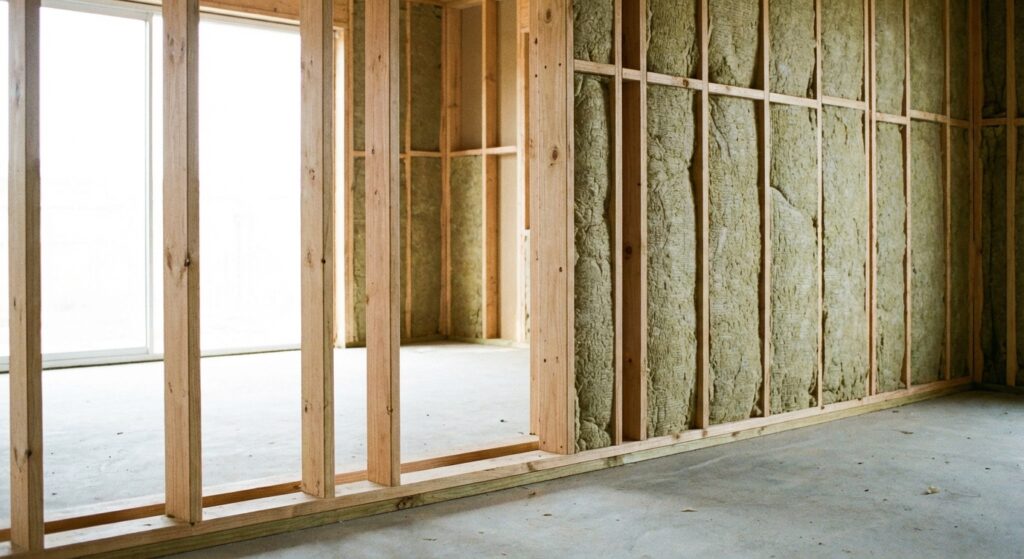
Double-wall assemblies provide complete structural separation. Two standard 2×4 walls, each with a separate bottom plate, are spaced 1 inch apart, creating an 8.5-inch total cavity when 0.5-inch gypsum board is applied to both outer faces. Testing conducted under ASTM E90 protocols shows this configuration achieves STC 63 when the cavity contains 6 inches of fiberglass batt insulation (density 3.5 pounds per cubic foot).
Mass-Loaded Vinyl Applications
Mass-loaded vinyl (MLV) is a dense, limp membrane containing barium sulfate or calcium carbonate particles in a polymer matrix. Standard formulations weigh 1 or 2 pounds per square foot; specialty products reach 4 pounds per square foot. The material blocks sound through mass law but remains flexible enough to avoid structural resonance frequencies that would reduce effectiveness.
Installation position determines performance. Applying MLV between two layers of gypsum board on the same stud face increases STC by 3-5 points, but introduces structural coupling issues—fasteners penetrating through MLV into studs create vibration bridges. The effective approach installs MLV on the stud face before the first gypsum layer, using acoustic caulk at all edges to seal air gaps. A second gypsum layer then covers the MLV, with no additional fasteners penetrating the studs.
Comparative testing reveals limitations. A standard staggered-stud wall with two layers of 5/8-inch Type X gypsum on each side achieves an STC of 54. Adding a 2-pound MLV to one side increases the rating to STC 57. The same wall using double-wall construction without MLV achieves STC 61. The data indicate that decoupling provides greater benefit per dollar than mass loading in residential applications.
Viscoelastic Damping Compounds
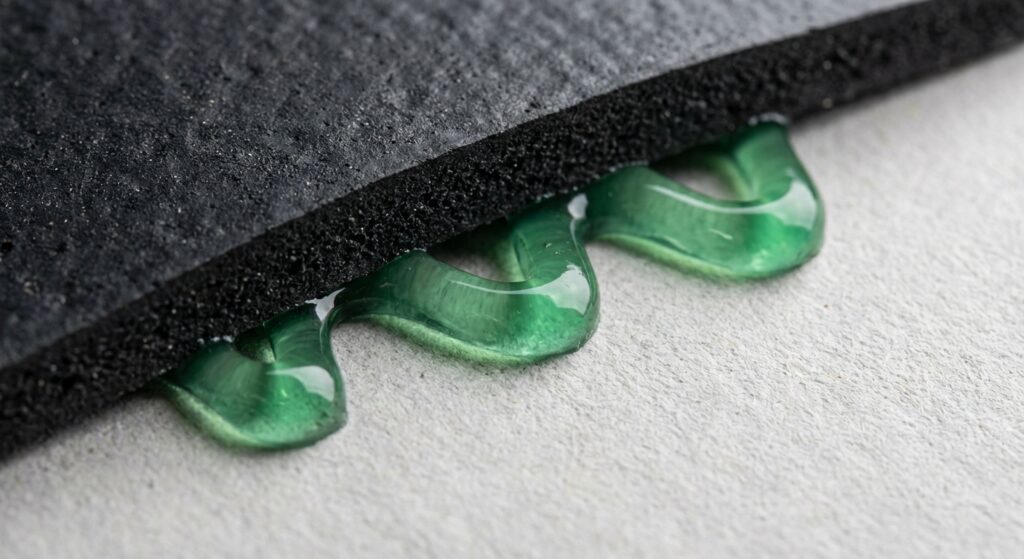
Green Glue, the dominant viscoelastic damping compound in residential acoustics, converts mechanical vibration energy into heat through shear deformation. The polymer formulation remains viscous rather than fully curing, maintaining damping effectiveness across temperature ranges typical of conditioned spaces.
Application requires spreading the compound between two rigid panels—typically two layers of gypsum board. As sound energy vibrates the outer gypsum layer, the panels move relative to each other, shearing the viscoelastic layer. Internal friction in the polymer converts molecular-level vibration energy into heat. Research from the Oak Ridge National Laboratory Building Envelope Program indicates that optimal performance requires 1-2 tubes (29 ounces each) per 4×8 sheet, applied in a serpentine pattern that covers 80% of the surface area.
The compound functions most effectively at frequencies between 200 and 2000 Hz, the range where human speech and most household noise concentrate. Testing shows Green Glue adds 5-7 STC points to double-layer gypsum assemblies on standard stud walls and 9-12 points on decoupled assemblies. The synergy occurs because decoupled walls reduce low-frequency transmission (below 200 Hz) while the damping compound addresses mid-frequencies.
Implementation Protocol for STC 60+
Achieving verified STC 60 in residential partitions requires combining multiple strategies. The proven assembly for luxury villa applications consists of:
Two independent 2×4 stud walls on separate sole plates, spaced 1 inch apart (9.5-inch total assembly thickness). Each cavity is filled with R-19 fiberglass batt insulation, unfaced, density 3.5 pounds per cubic foot. Inner gypsum layer: 5/8-inch Type X gypsum board, fastened to studs at 12-inch centers with acoustic sealant at all perimeter edges. Viscoelastic compound layer: Green Glue applied at 2 tubes per 32 square feet between gypsum layers. Outer gypsum layer: 5/8-inch Type X gypsum board, fastened only to the inner layer through the compound, not penetrating to studs.
This assembly measures 9.5 inches thick and weighs approximately 12 pounds per square foot, achieves STC 64 in laboratory testing, and costs $42-48 per square foot installed in Dubai market conditions as of 2024.
Door Systems and Flanking Transmission
Acoustic partitions fail when doors create flanking paths. Standard hollow-core residential doors achieve STC 18-25, undermining any wall assembly. The 1.75-inch door thickness features a cardboard honeycomb core between thin hardwood veneer faces – essentially an optimized acoustic membrane that transmits rather than blocks sound.
Solid-core doors improve performance through mass. A standard solid-core door (1.75-inch thickness, 45 pounds) achieves STC 28-32. Purpose-built acoustic solid-core doors add internal damping layers and perimeter seals. These assemblies reach STC 45-50 through four mechanisms: core mass (60-80 pounds), viscoelastic damping layers bonded to the core, automatic drop seals at the bottom threshold, and magnetic or compression gaskets on the hinge and latch jambs.
| Door Type | Core Construction | Weight | STC Rating |
|---|---|---|---|
| Hollow-core residential | Cardboard honeycomb | 25-30 lbs | 18-25 |
| Standard solid-core | Particleboard | 45-50 lbs | 28-32 |
| Acoustic solid-core | Mineral core + damping | 70-85 lbs | 45-50 |
| Double-door airlock | Two acoustic doors, 12″ gap | 140-170 lbs total | 55-60 |
The perimeter seal detail proves critical. Air gaps as small as 1/8 inch around a door perimeter reduce wall STC from 60 to 35. According to data from the U.S. Department of Energy Building Technologies Office, a 1/8-inch gap around a 3×7 door represents 5.25 square inches of open area—equivalent to a 2.5-inch diameter hole through the wall. Acoustic doors require three-sided compression gaskets and automatic drop seals that engage when the door closes, maintaining continuous contact pressure.
ASTM E90 Testing Methodology
ASTM E90 establishes standardized laboratory testing for airborne sound transmission. The procedure requires two reverberant rooms separated by an opening where the test partition is installed. The source room contains loudspeakers generating pink noise across the 125-4000 Hz frequency range at sound pressure levels of 90-100 dB. Microphones in both rooms measure sound pressure at multiple positions. The difference between the source and receiving room levels, adjusted for the room’s absorption characteristics, yields the transmission loss at each frequency.
STC ratings are derived by plotting transmission loss across frequencies and comparing the curve to standard reference contours defined in ASTM E413. The STC number represents the reference contour value at 500 Hz, adjusted to fit the test data according to specific rules governing maximum deviations. Laboratories accredited under ISO/IEC 17025 standards perform these tests, with facilities at major universities and specialized testing companies.
Field testing under ASTM E336 measures installed performance but typically yields ratings 5-8 points lower than those from laboratory testing. The gap reflects flanking transmission through floor and ceiling connections, electrical boxes, HVAC penetrations, and construction variations. Dubai luxury villa projects require field verification testing after installation, with contractual requirements to achieve minimum STC 55 field ratings when laboratory ratings target STC 60+.
The Privacy-Openness Paradox in Dubai Villas
Contemporary luxury villas in Dubai emphasize open floor plans with 4.5-meter ceiling heights, continuous sightlines through 40-foot living spaces, and minimal visual barriers. Clients request these spatial qualities while simultaneously demanding that a teenager’s bedroom music studio, a ground-floor home theater, and a second-floor master suite operate without acoustic interference. The contradiction requires strategic acoustic zoning.
The solution segments the residence into acoustic districts. Public zones (living, dining, kitchen) accept ambient sound transmission and use standard construction (STC 38-42). Private zones (bedrooms, studies, prayer rooms) receive enhanced partitions (STC 50-55). Critical zones (music rooms, home theaters, master suites) employ maximum isolation assemblies (STC 60-65). Transition spaces (hallways, staircases) function as acoustic buffers with additional mass-loaded drywall and carpet underlayment.
This zoning approach allocates acoustic investment where privacy expectations peak while maintaining architectural openness in communal areas. A 12,000-square-foot villa might employ STC 60+ partitions across 800 linear feet (15% of total partition length) while using standard construction for the remaining 85%. The targeted approach delivers privacy where required without the spatial penalties and budget impact of isolating every room.
Integration with MEP Systems
Mechanical, electrical, and plumbing penetrations through acoustic partitions create flanking paths that undermine STC ratings. A single electrical outlet box recessed into a stud cavity creates a 12-square-inch opening through the partition. Back-to-back boxes on opposite sides of a wall, in the same stud bay, essentially perforate the assembly.
The protocol requires offset installation – electrical boxes on opposite sides of the wall, located in different stud bays, with a minimum 16-inch horizontal separation. Each box receives acoustic putty pads installed between the box and the gypsum board before drywall installation. HVAC ducts penetrating acoustic partitions must include duct silencers—internal fiberglass-lined baffles that absorb sound energy traveling through the duct system. Transfer grilles, commonly used to balance air pressure between rooms, require acoustic louvers with internal sound-absorbing baffles, adding $120-180 per grille compared to standard models.
According to ventilation standards published by ASHRAE, bedroom ventilation requires 15-20 CFM per occupant. Achieving this airflow through acoustic louvers rather than undercut doors or transfer grilles maintains partition integrity while meeting building code requirements. The integrated approach coordinates architectural, acoustic, and MEP design from initial planning rather than resolving conflicts during construction.
Cost-Performance Analysis
Acoustic performance improvements follow diminishing returns. Moving from STC 33 (standard construction) to STC 45 (staggered studs, insulation) costs approximately $8-12 per square foot and delivers a noticeable improvement in privacy against typical household noise. Reaching STC 55 (double wall, damping compound) costs $25-35 per square foot and provides adequate privacy for music practice or home theater use. Achieving STC 60+ (double wall, damping, acoustic doors) demands $50-70 per square foot and ensures privacy for recording studios or confidential business conversations.
The investment calculation depends on the cost of the privacy violation. A family spending $4.8 million on a villa but unable to conduct business calls from the home office because children’s playroom noise intrudes represents a design failure exceeding any acoustic construction premium. Similarly, master suite privacy compromised by home theater sound transmission results in ongoing quality-of-life degradation that no furnishing or finish upgrade can remedy.
Return on investment materializes through space utilization. A home office achieving STC 60 isolation functions as a productive workspace during business hours, while adjacent spaces serve other purposes. Without acoustic privacy, the office remains underutilized or requires household schedule coordination that constrains family lifestyle. The acoustic investment effectively creates additional functional square footage by enabling simultaneous, conflicting uses of adjacent spaces.

Verification and Documentation
Post-construction acoustic testing verifies installed performance and identifies remediation requirements before finishes conceal assemblies. Field testing under ASTM E336 measures actual transmission loss between completed rooms. The procedure uses similar equipment to laboratory testing but faces challenges from smaller room volumes, irregular shapes, and flanking paths through connected spaces.
Testing occurs after gypsum installation but before painting, when remediation remains economically feasible. If testing reveals shortfalls—STC 52 when the specification requires STC 60—corrections might include adding an additional gypsum layer with damping compound, sealing overlooked penetrations, or upgrading door systems. Post-finish corrections require demolition and reconstruction, multiplying costs by factors of 3-5.
Documentation includes test reports with frequency-specific transmission-loss data, photographs of critical details during construction (stud configurations, insulation installation, seal applications), and as-built drawings showing the locations of acoustic partitions, door specifications, and penetration details. This documentation serves warranty purposes, future renovation planning, and provides verified performance data for similar future projects.
Material Specifications for Dubai Climate
Dubai’s climate creates specific material performance requirements. Interior spaces maintain 22-24°C through continuous HVAC operation while exterior conditions reach 45-50°C. This temperature differential and the low indoor humidity (30-40%) affect acoustic materials.
Fiberglass insulation performs consistently across temperature ranges, but unfaced material without paper or foil backing is required to prevent moisture condensation at temperature boundaries. Mineral wool insulation supports fire-rated assemblies and maintains acoustic performance at higher densities of 6-8 pounds per cubic foot, making the material suitable for maximum isolation zones. Viscoelastic damping compounds remain effective across the 18-30°C range typical of conditioned spaces, but applications on exterior walls lose effectiveness when surface temperatures exceed 40°C. Further guidance on UAE heat and humidity explains how local exposure conditions affect material selection.
Gypsum board selection favors Type X (fire-rated) formulations for acoustic partitions. The increased density (2.2 pounds per square foot for 5/8-inch Type X versus 1.8 pounds per square foot for standard gypsum) provides modest STC improvements while meeting fire code requirements. Moisture-resistant formulations (green board, purple board) offer no acoustic advantage and should be selected based on location-specific moisture exposure rather than acoustic criteria.
Construction Supervision and Quality Control
Achieving specified STC ratings requires construction precision uncommon in standard residential work. Acoustic sealant must fill every gap at partition perimeters—ceiling, floor, and end walls. Electrical boxes require putty pads. Insulation must completely fill cavities, without compression or gaps. Gypsum board joints require full-surface tape and compound, not just cosmetic finishing.
Quality control inspection occurs at multiple stages: framing inspection verifies stud configuration, spacing, and separation before insulation installation; insulation inspection confirms proper density, complete cavity filling, and absence of compression before gypsum installation; rough acoustic inspection examines seal details, penetration treatments, and door frame preparation before second gypsum layer; final inspection before painting verifies all joints sealed, fastener spacing correct, and door hardware complete.
Site supervision by acoustical consultants during critical phases prevents common errors. Electricians accustomed to standard practice install back-to-back outlet boxes at the same stud location, creating a 24-square-inch perforation through the partition. HVAC installers core-drill duct penetrations without subsequent sealing. Carpenters install door frames without confirming that the jamb width matches the actual partition thickness, creating gaps at the frame-to-wall junctions. Each error degrades performance by 3-8 STC points. Supervision costs $1,200- $ 1,800 per visit but prevents remediation costs exceeding $15,000 per partition.
Regulatory Framework and Building Codes
Dubai Municipality’s building codes reference the International Building Code (IBC) for fire and structural requirements, but lack specific acoustic performance mandates for residential construction. This absence means acoustic specifications derive from client requirements rather than regulatory compliance, shifting responsibility to design professionals.
Fire-rated acoustic partitions must meet both acoustic and fire-resistance requirements. A 2-hour fire-rated partition achieving STC 60 requires specific assembly details—Type X gypsum board, minimum thickness, fastener specifications, and joint treatment—that differ from assemblies optimized solely for acoustics. Design specifications must integrate both requirements, and testing must verify both performance criteria using separate protocols (ASTM E119 for fire resistance and ASTM E90 for acoustics).
International acoustic standards, such as those published by the International Organization for Standardization Technical Committee on Acoustics, provide reference criteria for residential acoustic quality. The ISO 12354 series of standards addresses prediction methods for building acoustic performance. While not mandatory in Dubai residential construction, these standards inform design specifications and testing protocols for luxury villa projects where clients expect performance levels exceeding minimum regulatory requirements.